
Landing as a Group: Coordinating a DIA Pickup for Ten or Forty
The board is flying in for the Thursday strategy offsite. Fourteen people, six different cities, and inbound flights scattered from 9:47 a.m. to 2:15 p.m. Someone has to make sure every arrival ends the same way, at the curb, in the right vehicle, on the way downtown. That someone is usually you.
You have already booked the hotel block, the meeting rooms, and the dinner reservation. Now the airport piece looms, because it is the one part where a single late flight can unravel the whole afternoon. If three executives sit waiting on a fourth whose connection slipped, the day starts behind.
Coordinating group transportation from DIA is not about finding one big vehicle. It is about running many arrivals across a window without anyone standing alone on a sidewalk. This post is the playbook we use for boards, teams, and conference groups landing on staggered flights, whether you are moving ten people or forty.
Why group arrivals are harder than they look
A single traveler is simple. Your driver watches one flight, one bag claim, one curb. A group is a moving target, because flights rarely land together and rarely land on time.
Denver International sits 25 miles from downtown, and the drive runs 35 to 45 minutes in normal traffic. That gap matters when arrivals are spread across four hours. Send everyone in one vehicle and your first arrivals wait ninety minutes for the last. Send everyone separately and you lose the single point of contact that keeps the day calm.
The real work is triage. Which arrivals group cleanly onto one run, which need their own vehicle, and which flight is most likely to slip. Get that grid right and the group barely notices the logistics. Get it wrong and you are fielding texts from a parking garage.
Step one, build the flight grid
Before we assign a single vehicle, we build a flight grid. It is a simple table, and it is the backbone of the whole plan.
For each traveler, we capture the airline, flight number, scheduled arrival, and city of origin. Then we sort by landing time and look for natural clusters. Four people landing between 10:00 and 10:40 can share one run. A straggler landing at 1:15 gets grouped with the next cluster or given a dedicated vehicle, depending on how long the earlier arrivals would wait.
We would rather you send us a rough passenger list early and refine it later than wait for perfect information. Names change, flights change, and someone always books late. The grid is built to flex.
Once the grid is set, every inbound flight on it is flight-monitored. If a connection slips in Chicago, we see the new arrival time before your traveler has cleared the jet bridge, and we adjust the run so the rest of the group is not stranded waiting.
Step two, group people onto sensible runs
With the grid in hand, we assign vehicles to clusters, not to individuals. The goal is short waits and full seats.
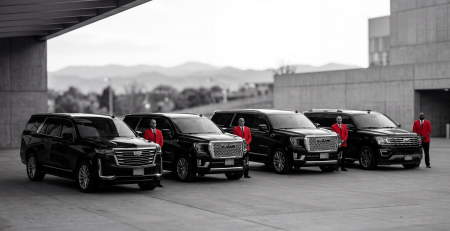
Our fleet is built for exactly this. A Mercedes Sprinter carries up to 14 passengers at $375 one-way, which handles most single-cluster arrivals in one clean move. For the large groups, the Grech GM40 seats up to 38 at $875 one-way, enough for a full conference contingent landing in one wave. When a cluster is small or an executive prefers to travel separately, we assign an SUV from the fleet, a Cadillac Escalade, a GMC Yukon Denali, or a Ford Expedition.
Here is how it plays out for a mid-size group. Say twenty people land across a three-hour window. The morning cluster of twelve rides the Sprinter downtown. The early-afternoon cluster of eight takes a second Sprinter or a pair of SUVs. Two vehicles, two runs, and nobody waits more than a few minutes at the curb.
For a forty-person conference group, the math often points to the Grech GM40 for the main wave and SUVs for the early and late outliers. One vehicle moves the bulk of the group in a single trip, and the outliers get right-sized rides instead of an empty coach.
Step three, one coordinator and one clean invoice
The part that makes an EA’s week is this. You get one point of contact, not a phone tree.
You send us the passenger list and the flight details. We build the grid, assign the vehicles, and confirm the plan back to you in plain language. On arrival day, you have one number to text if anything changes, and we handle the rest across every vehicle and every run.
When it is over, you get one clean invoice for the whole group, not a stack of separate receipts to reconcile. For a coordinator juggling expense reports across a board or a conference budget, that single invoice is worth as much as the smooth curb. Gratuity of 20 percent is added at booking, so there is nothing to sort out in the moment.
What the curb actually looks like
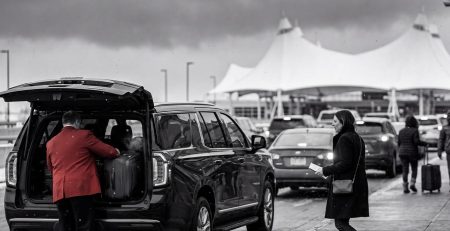
Every arrival ends the same way. Your driver greets your group at the assigned pickup zone in a red jacket, easy to spot in the flow of the terminal exits.
To be clear about how this works, your driver does not come inside the terminal. The greeting is curbside, at the pickup zone we assign and send to each traveler in advance. That keeps the pickup fast and predictable, which matters most when you are moving a crowd. Your travelers walk out, see the red jacket, and load up.
Because every flight on the grid is flight-monitored, your driver is already at the curb when the group clears baggage. There is no calling to say we have landed and no waiting for a vehicle to circle back. We track the inbound, time the approach, and we wait for you.
A note on the DIA pickup zones
DIA is one of the largest airports in the country by footprint, and the arrivals level can feel like a maze to a group that just flew in. This is where knowing the ground pays off.
We assign a specific pickup zone and send it to your travelers ahead of time, so nobody wanders. For larger vehicles like the Sprinter and the Grech GM40, the loading logistics differ from a sedan pickup, and our drivers know exactly where those vehicles stage and how to keep a group of thirty-eight moving without a scrum on the sidewalk.
Weather is the other Colorado variable. Spring and fall can turn a clear morning into a snow squall on the way downtown. Our drivers know these roads and these conditions, and flight monitoring lets us adjust timing when a storm slows the inbound flights themselves.
When something else might fit
We are not the right answer for every group, and we would rather tell you plainly.
If your group is arriving on a single flight and everyone lands together, you may not need the full grid-building process. One vehicle and one confirmation might be all it takes, and we can set that up in a few minutes.
If you are moving a very large crowd that exceeds even the Grech GM40, say a full conference of a hundred, a motorcoach charter company is built for that scale. We happily run the executive and VIP layer of a big event while a larger operator moves the general attendees. And if your people prefer to self-direct with individual arrivals on their own timelines, the app model can cover scattered singles, though it breaks down the moment you need one plan, one contact, and one invoice for the group.
For boards, teams, and conference groups of roughly ten to forty landing across a window, this is exactly what we are built for.
FAQ
How do I coordinate one airport pickup for a group of 14 to 40 people arriving on different flights at DIA? Send us your passenger list with each traveler’s flight details. We build a flight grid, group arrivals into sensible runs by landing time, assign vehicles, and flight-monitor every inbound so a late flight does not strand the rest. You get one coordinator and one invoice.
What vehicles handle large groups? The Mercedes Sprinter carries up to 14 passengers at $375 one-way. The Grech GM40 carries up to 38 at $875 one-way. For smaller clusters and outliers, we assign SUVs like the Escalade, Yukon Denali, and Expedition.
What if some flights are delayed? Every flight on your grid is flight-monitored automatically. If an arrival slips, we see the new time and adjust that run, so the rest of the group is never left waiting on one late connection.
Can we get one invoice for the whole group? Yes. One coordinator manages the entire booking, and you receive one clean invoice for every vehicle and every run, not a pile of separate receipts. A 20 percent gratuity is added at booking.
Where does the driver meet us? Your driver greets your group curbside at the assigned pickup zone in a red jacket. We send the zone to each traveler in advance. Your driver does not enter the terminal, which keeps a group pickup fast.
How far is DIA from downtown Denver? The airport sits about 25 miles from downtown, and the drive runs 35 to 45 minutes in normal traffic. We factor that gap into how we cluster arrivals so nobody waits long at the curb.
How early should we book a group? The sooner the better, especially during conference and gala season. Send a rough list early and refine names and flights later. The grid is built to flex as details change.
Do you provide car seats for families traveling with the group? Yes, car seats are $35 each and provided for your convenience. For liability reasons the traveler installs the seat, and our team is glad to hand it over at the curb.
See you at the curb
A group arrival should feel like the easy part of the trip, not the anxious one. When the grid is built, the runs are grouped, and every flight is flight-monitored, ten people or forty step off their flights and find the same calm curb.
You get one coordinator, one plan, and one clean invoice. Your travelers get your driver in a red jacket, ready at the assigned zone, no matter when their flight lands.
That is the whole promise. You run the meeting. We run the arrivals. We wait for you.
Ready to plan your group’s DIA pickup? Text or call 303-717-8113, or book at drivedenvercarservice.com.






Leave a Reply