
Denver Wedding Transportation: A Practical Guide for Couples (and Their Planners)
The transportation decisions most couples do not realize they need to make until the week of, and how to plan them in a way that holds the timeline together.
It is 9:43 a.m. The bride is in her dress, in a hotel suite. The ceremony is at 11 in Evergreen, 35 minutes away. The bridal party of eight was supposed to load into the Sprinter at 9:30. Two bridesmaids are still on the elevator. Your driver is in the porte-cochère with the engine running. The day’s first timing slip is happening, and no one has noticed yet.
Wedding transportation does not show up in the photo album. It does not appear on the welcome bag. It is also the load-bearing logistics of the entire day. When it works, no one talks about it. When it does not, every other vendor down the line absorbs the delay.
This post is the practical guide most couples wish they had at the start of planning.
The Three Decisions Couples Do Not Realize They Need to Make
There are three core transportation decisions for a wedding, and most couples plan one and forget the others.
- How to move the wedding party between the getting-ready location, the ceremony, photo stops, the cocktail hour, and the reception.
- How to move out-of-town guests between hotels and the venue, in both directions.
- How the couple leaves the reception at the end of the night, and what comes after.
Decision one usually gets the most planning attention. Decision two gets under-planned, and the consequences show up at boarding time. Decision three is often forgotten until the week of, when the couple realizes they cannot drive their own car to the after-party in a wedding dress.
We will walk through each.
How Many Vehicles You Actually Need
The honest answer is ‘fewer than the upsell suggests, more than your spreadsheet shows.’ Here is the working math.
Wedding party vehicle
- A party of six to eight people: one Sprinter (15-passenger) is more comfortable than two SUVs and costs less per hour.
- A party of 10 to 14 people: a Mini Coach (32-passenger) is the right move. Two Sprinters means two timelines to coordinate.
- A party of 15 or more: one Mini Coach. Always one vehicle. Two means a timing split, and the photographer hates that.
Guest shuttle vehicles
- Up to 30 guests at one hotel: one Sprinter or one Mini Coach (32-passenger), depending on the gap between trips.
- 30 to 60 guests at one hotel: one Mini Coach (38-passenger) running a loop.
- Larger blocks: two vehicles, staggered by 30 minutes, so loading does not stall.
Couple’s exit vehicle
- One SUV. Just the couple, sometimes plus parents to the after-party. Yukon, Denali, or Escalade.
A common mistake: booking a single guest shuttle for a 100-guest wedding. One vehicle cannot do that work in one trip. You will need either two vehicles running parallel or one vehicle doing two round trips, and the second round trip is where guests start arriving stressed.
Vehicle Types and What Each Is For
The vehicle mix at DriveDenver, with what each is best at:
- Luxury SUV (Yukon, Denali, or Escalade). Up to six passengers. The right move for the couple’s exit, parents of the couple, or small VIP transport. Wedding-day rate: $100 per hour, four-hour minimum.
- Sprinter (15-passenger). Bridal parties of six to eight. Out-of-town guest shuttles for small blocks. $150 per hour with a four-hour minimum, or $375 for a one-way trip.
- Mini Coach (32-passenger). Mid-size wedding party transport, or guest shuttle. $210 per hour with a four-hour minimum, or $700 for a one-way trip.
- Mini Coach (38-passenger). Larger wedding party, or larger guest shuttle. $225 per hour with a four-hour minimum, or $875 for a one-way trip.
A note on capacity: published seat counts assume passengers without garment bags, gowns, or instruments. For comfort, subtract two from the seat count when the wedding party has full attire and bouquets.
The Day-of Timing Reality (where weddings break)
A few patterns repeat across nearly every wedding day. Plan for them.
The bridal party loads late, every time.
Build a 15-minute buffer into the call time, every leg of the day. Hair and makeup runs over. Someone forgets the rings. The dress needs a re-bustle. Your driver expects this, but the timeline does not absorb it unless you build the buffer in.
The ceremony-to-reception gap is rarely ‘a quick drive.’
Even when the venues are 10 minutes apart on a map, Saturday afternoon traffic, photo stops, and the bridal party’s last-minute stop at the suite all add up. Build 30 minutes into that leg.
Guest shuttles need multiple round trips.
A 50-guest shuttle in a 38-passenger Mini Coach is not one trip. It is two, with loading and unloading. Plan the first shuttle to leave 90 minutes before the ceremony starts, so the second trip arrives 30 minutes before.
The end-of-night shuttle is the hardest leg.
Guests are tired, often slightly intoxicated, sometimes lost from the group. Build a final departure window of 30 minutes (last call to last shuttle), not 10. Your driver will not rush the last guest, but cannot wait forever.
Your driver needs the timeline in writing.
The single most useful thing a planner or family-of-the-couple can give a chauffeur is the day-of timeline, with addresses and pickup times, the day before the wedding. Your driver builds the route around it. We send proactive updates throughout the day if anything shifts.
Out-of-Town Guest Transportation
Out-of-town guests are the most commonly over-planned and under-executed part of wedding transportation. A few principles that hold up:
- Pair the airport with a flight-monitored pickup. DIA pickups for wedding-block VIPs (parents, grandparents, the officiant flying in) should be flight-monitored. We wait for you. Flight delays do not become wedding-day problems.
- Build the hotel-to-venue shuttle around the ceremony start time. Guests should arrive at the venue 30 to 45 minutes before the ceremony begins, not 5 minutes before. The shuttle’s last departure from the hotel is 60 minutes before ceremony start.
- Make the return trip clear in writing. Hand every shuttle guest a card in their welcome bag that lists the return shuttle pickup times. Guests miss return trips when the times are word-of-mouth.
- Have a backup plan for stragglers. A handful of guests always miss the last shuttle. Have one SUV available for the final hour, or have your venue’s contact ready to call a ride. This is your driver’s job if it is part of the booking.
The Couple’s Getaway
The end-of-night exit gets the least planning and creates the most stress when it is skipped. A few things to think through:
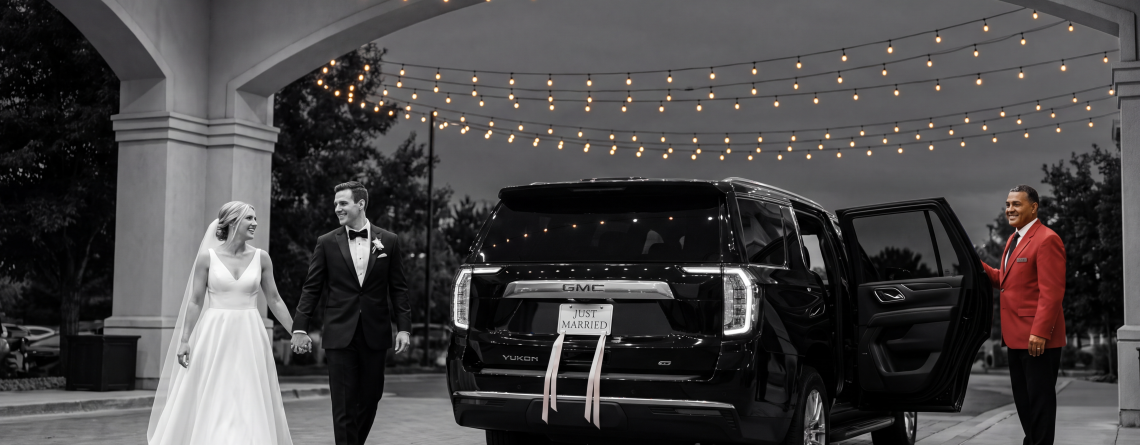
- The photographer will want an exit shot. A clean SUV in the porte-cochère, you walking out in your dress, the couple stepping in. Plan for that visual. Two minutes of attention pre-wedding saves a frustrating photo moment at midnight.
- After-party transport is part of the same booking. If you have an after-party at a downtown bar or back at the hotel suite, your driver takes you there. Same vehicle, same driver.
- The hotel arrival is your first private moment of the night. Door-to-door, your driver hands off any bags, the suite is ready, the door closes. That is the moment most couples remember.
- Champagne service on request. Brought to the vehicle in advance, chilled, with two flutes. Mention it at booking.
How Wedding Transportation Pricing Actually Works
There are three pricing models in wedding transportation. Most couples need a hybrid of all three.
- Per-trip (one-way). Best for: DIA airport pickups for individual guests, the couple’s one-way exit to the after-party or hotel.
- Hourly. Best for: the wedding party on the day (typically four to six hours), multi-stop guest shuttle loops, anything with waiting time built in.
- Per-event (round-trip flat). Used in concert and event transport. Rare in weddings, occasionally relevant for small destination wedding blocks.
A typical full-service Denver wedding transportation plan includes:
- Wedding party: one Sprinter or Mini Coach, four to six hours hourly.
- Guest shuttle: one Mini Coach, three to four hours hourly, or two one-way trips.
- Couple’s exit: one SUV, one-way trip.
- DIA pickups for parents-of-couple and VIPs: per-trip flat rate.
For a 100-guest Denver wedding with a moderate out-of-town block, the all-in transportation cost commonly runs $2,000 to $4,500, depending on vehicle mix and hours.
Five Common Mistakes (and How to Avoid Them)
- Booking the wedding party vehicle for the minimum hours. The minimum is four hours. A real wedding day uses six. Pay for the buffer.
- Booking only one guest shuttle for a 100-plus guest wedding. One vehicle cannot move 100 guests cleanly. Plan two, or plan multiple trips with a clear timeline.
- Forgetting the couple’s exit until the week of. The exit vehicle is part of the original booking. Add it to the proposal in the first conversation.
- Not giving your driver the timeline in writing. Verbal hand-offs at 9 a.m. on the wedding day are not reliable. Send the timeline 48 hours in advance.
- Skipping the day-of single point of contact. One person on the wedding side (planner, day-of coordinator, or designated family member) should be the only one texting your driver. Group texts on a wedding day do not work.
A Booking Checklist (by date)
90 days out
- Confirm vehicle types and number of vehicles.
- Confirm hourly bookings versus per-trip bookings.
- Send the working timeline (subject to change).
60 days out
- Lock the timeline with your planner.
- Share the timeline with the transportation lead.
- Confirm pickup addresses for the wedding party and any VIP DIA pickups.
14 days out
- Lock final headcount for guest shuttles.
- Confirm all pickup addresses, names, and contact numbers.
- Designate the day-of single point of contact.
Day before
- Send the final, locked timeline in writing.
- Confirm any decoration or signage requests.
- Confirm champagne service and any special preparations.
What’s Included When DriveDenver Handles Your Wedding Transportation
- A professional chauffeur in formal attire, in a clean, current-model luxury vehicle.
- Door-to-door routing for the wedding party between all venues.
- Flight-monitored pickups with meet-and-greet for out-of-town VIPs at DIA.
- Multi-stop coordination handled in advance.
- A pre-wedding timeline review with your chauffeur and your point of contact.
- Proactive updates throughout the day. Your point of contact gets the check-ins before they have to ask.
- Champagne service, ‘Just Married’ placards, or signage on request.
- Real-time route adjustments for traffic or timeline shifts.
- We wait for you. The bridal party runs late. Your driver expects it.
Frequently Asked Questions
How early should we book?
Twelve months out for a Saturday wedding in peak weeks. Six to nine months out for off-peak. Three months out is workable but limits vehicle choice.
What is the minimum hours for a wedding party SUV?
Four hours, on the day. Most full wedding days book six hours of wedding party transport.
Can we have multiple vehicles on different schedules?
Yes. Most weddings of 80-plus guests use at least two vehicles, often three. Coordination across drivers is handled by our dispatch.
Do you provide a wedding shuttle for guests from the hotel?
Yes. Mini Coaches in 32- or 38-passenger configurations. Hourly or per-trip pricing, depending on the schedule.
What if the timeline shifts on the day?
That happens at most weddings. We adjust. Your driver communicates with your point of contact directly and re-routes as needed.
Is champagne and refreshment service allowed?
Yes, on request, in adult passenger vehicles. We bring it chilled. There is no corkage fee. We ask that you finish before reaching the venue.
Do you decorate the vehicle?
Light decoration is welcome (placard, ribbon at the back). Anything that attaches to the vehicle exterior needs prior approval.
What is the gratuity policy?
A 20% gratuity is added to the total. No additional gratuity is required, though many couples choose to tip the chauffeur directly at the end of the night.
The Bottom Line
Wedding transportation will not be the most photographed part of your day. It will be the load-bearing logistics that holds the timeline together. Plan it like every other vendor: the right vehicles, the right hours, the right driver, and a written timeline.
When it is done well, no one talks about the cars. The bride arrives composed. The guests get to the ceremony on time. The couple steps into the suite at midnight without thinking once about how they got there. That is the goal.
Request a Wedding Transportation Quote
Send your wedding date, headcount, and rough timeline to 303-717-8113 or drivedenvercarservice.com. We confirm with a vehicle plan and a custom quote within 2 hours.









Leave a Reply